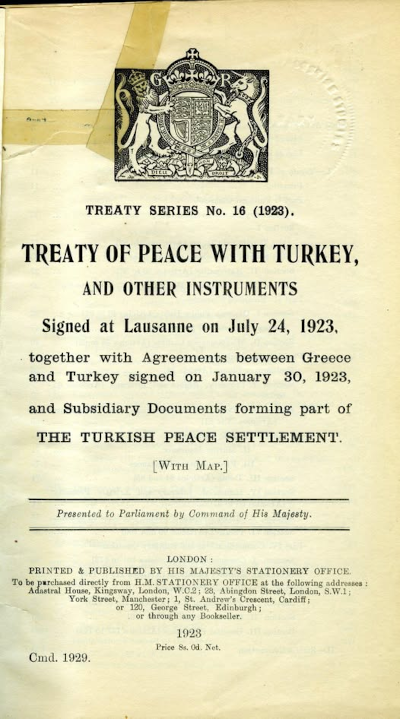
The treaty of Lausanne 1923:
The treaty of Lausanne 1923: did not
just issue a single blanket statement handing every unnamed piece
of rock to Greece. Instead, it established sovereignty using a
combination of explicitly named islands, geographic proximity
limits, and renunciation clauses.
To understand exactly how the treaty handles islands, islets, and rocks in the Aegean, it helps to look at the exact text across its key articles.
To understand exactly how the treaty handles islands, islets, and rocks in the Aegean, it helps to look at the exact text across its key articles.
1. The 3-Mile Rule (Article 12 &
Article 6)
The treaty establishes a baseline rule for geographic proximity to the mainland coast.
• Article 12 explicitly states that, unless there is a specific provision to the contrary, islands situated at less than three miles from the Asiatic (Turkish) coast remain under Turkish sovereignty.
• Article 6 reinforces this by stating that, in the absence of provisions to the contrary, islands and islets lying within three miles of the coast are included within the frontier of the coastal State.
Consequently, any unnamed islet or rock located more than 3 miles from the Turkish coast does not automatically default to Turkey under this proximity rule.
The treaty establishes a baseline rule for geographic proximity to the mainland coast.
• Article 12 explicitly states that, unless there is a specific provision to the contrary, islands situated at less than three miles from the Asiatic (Turkish) coast remain under Turkish sovereignty.
• Article 6 reinforces this by stating that, in the absence of provisions to the contrary, islands and islets lying within three miles of the coast are included within the frontier of the coastal State.
Consequently, any unnamed islet or rock located more than 3 miles from the Turkish coast does not automatically default to Turkey under this proximity rule.
2. Specific Islands Passed to Greece
(Article 12)
Article 12 confirms Greek sovereignty over the major islands of the Eastern Mediterranean (Aegean) that Greece had already taken control of during the Balkan Wars. It explicitly names:
• Lemnos, Samothrace, Mytilene (Lesbos), Chios, Samos, and Ikaria.
The only explicit exceptions retained by Turkey in this specific sector were Imbros (Gökçeada), Tenedos (Bozcaada), and the Rabbit Islands, due to their strategic positioning right at the mouth of the Dardanelles.
Article 12 confirms Greek sovereignty over the major islands of the Eastern Mediterranean (Aegean) that Greece had already taken control of during the Balkan Wars. It explicitly names:
• Lemnos, Samothrace, Mytilene (Lesbos), Chios, Samos, and Ikaria.
The only explicit exceptions retained by Turkey in this specific sector were Imbros (Gökçeada), Tenedos (Bozcaada), and the Rabbit Islands, due to their strategic positioning right at the mouth of the Dardanelles.
3. The Renunciation of Ottoman
Rights (Article 16)
This is the most critical article regarding the legal status of the remaining unnamed islets and rocks. In Article 16, Turkey formally declared that it:
"...renounces all rights and title whatsoever over or respecting the territories situated outside the frontiers laid down in the present Treaty and the islands other than those over which sovereignty is recognized by the said Treaty..."
Because Turkey renounced all titles to islands outside its 3-mile border, the widely accepted international law interpretation (and the official position of Greece) is that sovereignty over adjacent islets and rocks passed to Greece as part of the broader administrative units of the main islands they cluster around.
This is the most critical article regarding the legal status of the remaining unnamed islets and rocks. In Article 16, Turkey formally declared that it:
"...renounces all rights and title whatsoever over or respecting the territories situated outside the frontiers laid down in the present Treaty and the islands other than those over which sovereignty is recognized by the said Treaty..."
Because Turkey renounced all titles to islands outside its 3-mile border, the widely accepted international law interpretation (and the official position of Greece) is that sovereignty over adjacent islets and rocks passed to Greece as part of the broader administrative units of the main islands they cluster around.
4. The Dodecanese (Article 15)
It is also worth noting that a massive cluster of islands in the southeastern Aegean—the Dodecanese—did not actually go to Greece under the Treaty of Lausanne.
• Under Article 15, Turkey ceded the Dodecanese islands (explicitly naming 13 of them, including Rhodes, Kos, and Carpathos) plus "the islets depending thereon" to Italy, which had been occupying them since 1912.
It is also worth noting that a massive cluster of islands in the southeastern Aegean—the Dodecanese—did not actually go to Greece under the Treaty of Lausanne.
• Under Article 15, Turkey ceded the Dodecanese islands (explicitly naming 13 of them, including Rhodes, Kos, and Carpathos) plus "the islets depending thereon" to Italy, which had been occupying them since 1912.
• These islands and their adjacent
islets were only later transferred from Italy to Greece following
World War II under the 1947 Paris Peace Treaty.
While the treaty successfully settled peace, the exact phrasing remains a core point of geopolitical friction today:
Articles 12 and 16 mean that Turkey’s sovereignty is strictly limited to its 3-mile coastal zone and the explicitly named exceptions (Imbros/Tenedos). Therefore, all other islands, islets, and rocks in the Aegean belong to Greece.
While the treaty successfully settled peace, the exact phrasing remains a core point of geopolitical friction today:
Articles 12 and 16 mean that Turkey’s sovereignty is strictly limited to its 3-mile coastal zone and the explicitly named exceptions (Imbros/Tenedos). Therefore, all other islands, islets, and rocks in the Aegean belong to Greece.