|
DEMOCRITUS (460-370 B.C.)
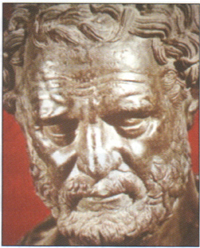 Greek philosopher, who developed the atomic theory of the universe
that had been originated by his mentor, the philosopher Leucippus.
Democritus was born in Abdera, Thrace. He wrote extensively, but
only fragments of his works remain. According to Democritus's
exposition of the atomic theory of matter, All things are composed
of minute, invisible, indestructible particles of pure matter (atoma,
=
"indivisibles"), which move about eternally in infinite empty space
(kenon, "the void"). Although atoms are made up of precisely the
same matter, they differ in shape, size, weight, sequence, and
position. Qualitative differences in what the senses perceive and
the birth, decay, and disappearance of things are the results not of
characteristics inherent in atoms but of quantitative arrangements
of atoms. Democritus viewed the creation of worlds as the natural
consequence of the ceaseless whirling motion of atoms in space.
Atoms collide and spin, forming larger aggregations of matter.
Democritus also wrote on ethics, proposing happiness, or
"cheerfulness", as the highest good-a condition to be achieved
through moderation, tranquillity, and freedom from fear. In later
histories, Democritus was known as the Laughing Philosopher, in
contrast to the more sombre and pessimistic Heraclitus, the Weeping
Philosopher. His atomic theory anticipated the modern principles of
the conservation of energy and the irreducibility of matter. Greek philosopher, who developed the atomic theory of the universe
that had been originated by his mentor, the philosopher Leucippus.
Democritus was born in Abdera, Thrace. He wrote extensively, but
only fragments of his works remain. According to Democritus's
exposition of the atomic theory of matter, All things are composed
of minute, invisible, indestructible particles of pure matter (atoma,
=
"indivisibles"), which move about eternally in infinite empty space
(kenon, "the void"). Although atoms are made up of precisely the
same matter, they differ in shape, size, weight, sequence, and
position. Qualitative differences in what the senses perceive and
the birth, decay, and disappearance of things are the results not of
characteristics inherent in atoms but of quantitative arrangements
of atoms. Democritus viewed the creation of worlds as the natural
consequence of the ceaseless whirling motion of atoms in space.
Atoms collide and spin, forming larger aggregations of matter.
Democritus also wrote on ethics, proposing happiness, or
"cheerfulness", as the highest good-a condition to be achieved
through moderation, tranquillity, and freedom from fear. In later
histories, Democritus was known as the Laughing Philosopher, in
contrast to the more sombre and pessimistic Heraclitus, the Weeping
Philosopher. His atomic theory anticipated the modern principles of
the conservation of energy and the irreducibility of matter.
Aristarchus Greek philospher to unravel
the celestial plan
Empedocles Greek philospher
to unravel the gravitational field of the universe
http://astrosun2.astro.cornell.edu/ |