|
PARMENIDES 500 B.C.
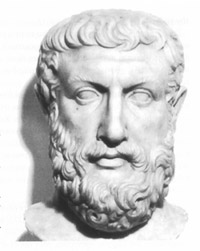 Parmenides, Greek philosopher, considered by many scholars to have been the
greatest member of the Eleatic school. He is said to have visited Athens at the
age of 65, and on that occasion Socrates, then a young man, heard him speak.
Parmenides expounded his philosophy in verse form, his only surviving work being
large fragments of a didactic poem, On Nature. This work argued for the
existence of Absolute Being, the non-existence of which Parmenides declared to
be inconceivable, but the nature of which he admitted to be equally
inconceivable, since Absolute Being is dissociated from every limitation under
which human beings think. Parmenides held that the phenomena of nature are only
apparent and due to human error; they seem to exist, but have no real existence.
He also held that reality, True Being, is not known to the senses but is to be
found only in reason. This belief makes him a precursor of the idealism of
Plato. Parmenides' theory that being cannot arise from nonbeing, and that being
neither arises nor passes away, was applied to matter by his successors
Empedocles
and Democritus, who made it the foundation of their materialistic
explanations of the universe. Parmenides, Greek philosopher, considered by many scholars to have been the
greatest member of the Eleatic school. He is said to have visited Athens at the
age of 65, and on that occasion Socrates, then a young man, heard him speak.
Parmenides expounded his philosophy in verse form, his only surviving work being
large fragments of a didactic poem, On Nature. This work argued for the
existence of Absolute Being, the non-existence of which Parmenides declared to
be inconceivable, but the nature of which he admitted to be equally
inconceivable, since Absolute Being is dissociated from every limitation under
which human beings think. Parmenides held that the phenomena of nature are only
apparent and due to human error; they seem to exist, but have no real existence.
He also held that reality, True Being, is not known to the senses but is to be
found only in reason. This belief makes him a precursor of the idealism of
Plato. Parmenides' theory that being cannot arise from nonbeing, and that being
neither arises nor passes away, was applied to matter by his successors
Empedocles
and Democritus, who made it the foundation of their materialistic
explanations of the universe.
|