The Nine Muses
MELPOMENE - TERPSICHORE - POLYHYMNIA - CALLIOPE - EUTERPE - URANIA - THALIA - ERATO - CLIO
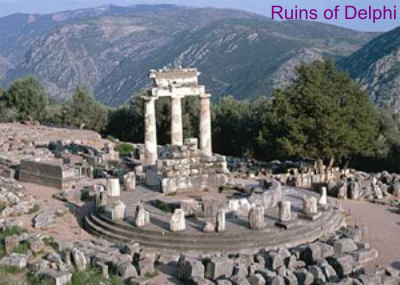
ORACLES were many such places in the ancient Greek world, most notably at Delphi,
Didyma on the coast of Asia Minor, Dodona in Epirus, and Olympia.
World wide information kept in
safety to recall them when needed. Greek historian Hesiod lines
38-40: «είρουσαι τά τ' εόντα τά τ' εσσόμενα πρό τ' εόντα,
φωνή ομηρεύσαι τών δ' ακάματος ρέει αυδή εκ στομάτων
ηδεία...». (=people seeking information from the
muses, the information was read to the people exactly as it was
written, with the only difference that the muses had to create
poems and sing it to their clients because the majority of the
people where illiterate, and it is easier to remember a poem than
the actual words, the word ομηρεύσαι (=captured, kept, stored)
indicating that the words where written and stored in safety.
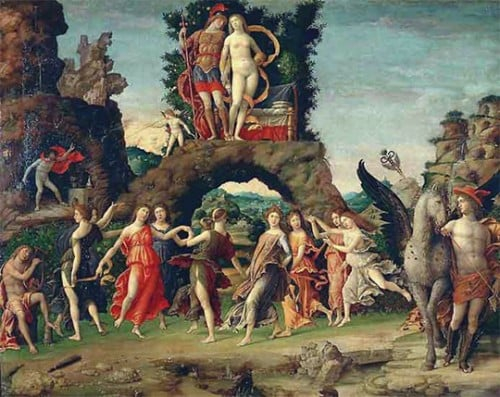
the 9 muses
The Nine Muses have been inspiring
artists since the antiquity and there countless paintings,
drawings, designs, poems and statues dedicated to them. All
artists of the Renaissance acknowledged their importance in
artistic creation, dedicating their works to the Muses. Today, the
most famous depiction of the Muses in sculpture is in Greece, in
Corfu; the Empress Sissi of Austria had their statues made for
her, in order to ornament the garden of her retreat house in
Corfu, the famous Achilleion.


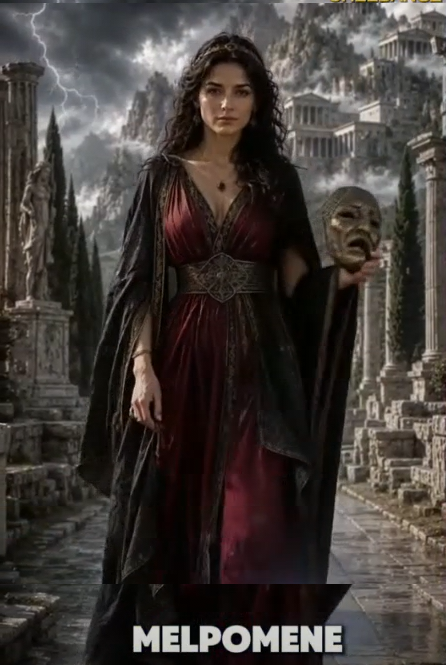
MUSEUM ORACLE ΜΕΛΠΟΜΕΝΗ
(=MELPOMENE) ΜΕΛ=MEL=melodrama (acting), ΠΟ=πόσις PO=posis (=wine
drinking) «Greek tragedy» the word tragedy is related to ancient
times, τράγος (=tragos the male goat (billy-goat), (trag+odi=
τραγ+ωδί=acting and sinning). Goat herdsmen of the Greek mountains
often under wine influence, dress with goat skins to perform and
amuse them selves acting as male goats with at first unpleasant
comic sexual behavior, the idea led to gradual evolution of a
proper musical - theatrical prototype. The muse is pictured in an
acting position, standing holding Hercules club, and she wears a
mask of him. Oracle MELPOMENE was teaching theater, enriching
heroism to the young and high spirit to others Melpomene: Opposite
from Thalia, Muse Melpomene was the protector of Tragedy; she
invented tragedy, rhetoric speech and Melos.


MUSEUM ORACLE ΤΕΡΨΙΧΟΡΗ
(=TERPSICHORE) TERPSI= pleasure, satisfaction, happiness
CHORE=chorus, sing and dance, she is always following MELPOMENE in
the theatre. She teaches music and dance. the lyre (guitar) symbol
of divination to God Apollo. Terpsichore: was the protector
of dance; she invented dances, the harp and education. She was
called Terpsichore because she was enjoying and having fun with
dancing ( “Terpo” in Greek refers to be amused). She was depicted
wearing laurels on her head, holding a harp and dancing.

MUSEUM ORACLE ΠΟΛΥΜΝΙΑ (=POLYHYMNIA)
POLY=the greatness of a substance, HYMNIA emerges from the word
ΥΦ-ΥΦΑΙΝΩ(=weave) weaving words and writings of information as
well in tapestry. In Homer (Ιλιάς Ζ 169-170) we read «Γράψας
(Γράψας=he wrote - writes) εν πινάκι πτυκτώ θυμοφθόρα πολλά»
[he wrote fearfully events on double wooden plaques and he
folded them]. Museum Polyhymnia was a work place of
weaving writings and storing the information. Polyhymnia portrayed
with her finger-pointer in front of her mouth symbolizing silence.
Oracle Polyhymnia was the protector of the divine hymns and mimic
art; she invented geometry and grammar. She was depicted looking
up to the Sky, holding a lyre.
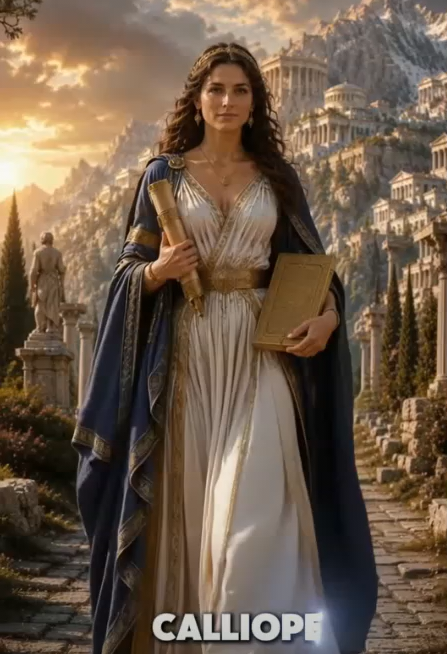
MUSEUM ORACLE ΚΑΛΛΙΟΠΗ (=CALLIOPE)
KALLI (=good, right, brilliant, etc., OPE=open eye, broad vision.
The many languages of Greece Achaea, Crete, Dorea, Cydon, Pelasgia
originating from Zeus era causing confusion. The museum CALLIOPE
considered as the greatest offer, sorting out the many words of
the seamen to be understood by the people of the mountains and
vice versa and in all regions and trades, and to create a common
dictionary. ΓΛΩΣΣΑ(=GLOSSA=toque=language=knowledge) the knowledge
of many words to rise the level of civilization. CALLIOPE
portrayed seated in a thinking position her elbow resting on her
knee, holding pen feather and plaques, her appearance showed that
she was ready to read those plaques. (the Greek writing is as old
since the appearance of Zeus more than 15.000 years old, long
before the appearance of the Phoenicians). Muse Calliope was the
superior Muse. She was accompanying kings and princes in order to
impose justice and serenity. She was the protector of heroic poems
and rhetoric art. According to the myth, Homer asks from Calliope
to inspire him while writing Iliad and Odyssey, and, thus,
Calliope is depicted holding laurels in one hand and the two
Homeric poems in the other hand.
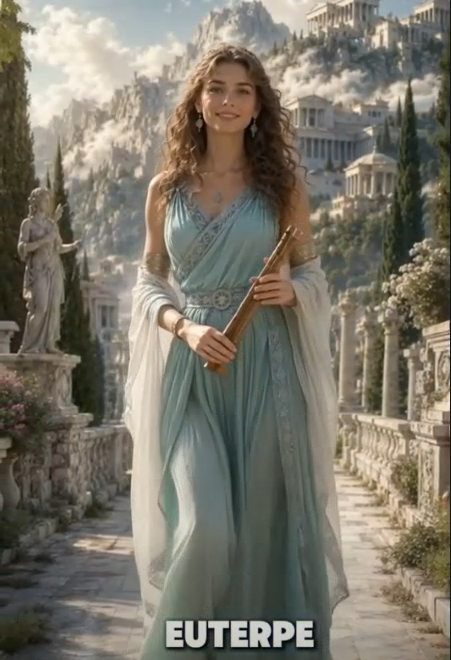
MUSEUM ORACLE ΕΥΤΕΡΠΗ (=EUTERPE)
EY=EU(=good, happy, enjoy) ΤΕΡΠΗ(= pleasurable, satisfied) The
happy muse related with teaching music, dancing, wine making, and
she is close related with Bacchus (=Dionysus) her music is the
bag-pipes, double-pipes, and the flute. She kept information of
all kinds of traditional music of her known world. Muse Euterpe
discovered several musical instruments, courses and dialectic. She
was always depicted holding a flute, while many instruments were
always around her.

MUSEUM ORACLE ΟΥΡΑΝΙΑ (=URANIA)
(=URANUS=SKY) In Theogony=Greek Genesis «historian Hesiod (800-750
b.c.) conceded that the information of Theogony came from the
muses of the Heliconian mountains (Oracle)». (At first there was
Chaos after the Erebus and the night next the daylight next the
sky the Earth and Eros).... «THEOGONY is a mythological code of
facts but not a religion, the pre-philosophic and pre-scientific
progress of the Paleolithic Greeks» At the beginning existed the
CHAOS, GAEA (=matter) and EROS (attractiveness=gravity), from
Chaos begat Erebus and the Night and from those two begat the
Ether (a substance permitting light to travel) and the day-light.
At the same time begets the Gaea (Earth) including the Uranus
(=sky+stars), and from those two begets the Ocean, Coeus, Creaeus,
Hyperion (=Galaxy), Iapetus, and Cronus including the Cyclopes
Brontes, Steropes, and Arges (the TITANS). Thaea, Rhea, Themis,
Mnemosyne (=memory), Phoebe, Tethys (the TITANESS). Muse Urania
was the protector of the celestial objects and stars; she invented
astronomy. She was always depicted bearing stars, a celestial
sphere and a bow compass.
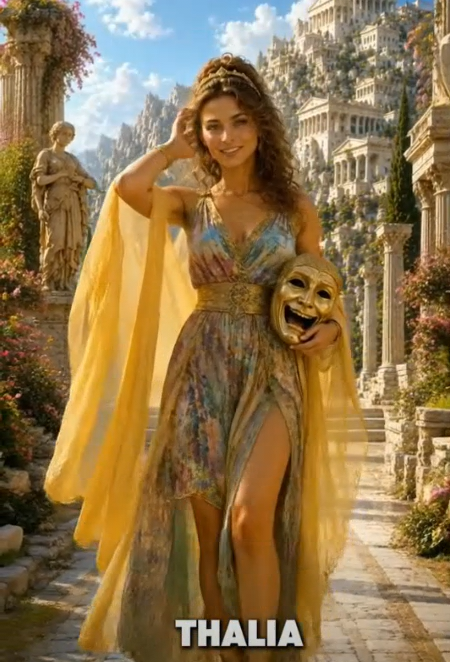
MUSEUM ORACLE ΘΑΛΕΙΑ (=THALIA)
ΘΑ=ΤΗΑ= oversee, attend, observe sea and land weather conditions.
She was teaching people fishing, stock breeding, agriculture and
the technique of managing seedlings and nursing plants. She also
advising seamen to understand weather conditions and to observe
the constellation of Pleiades and the Star Orion, Sirius, and Ursa
Major. She was teaching the preparation of works to be done on the
changing of the seasons [when the stars Orion and Sirius reach the
centre of the sky, and the Ursa Major facing the morning star it
is time to vine harvest and bring all the grapes home. (Hesiod
Έργα και ημέρες lines 609-611)]. Her appearance with garland of
vine, dressed in kirtle holding in one hand Dionysus mask and a
teaching-stick in the other. Muse Thalia was the protector of
comedy; she discovered comedy, geometry, architectural science and
agriculture. She was also protector of Symposiums. She was always
depicted holding a theatrical – comedy mask.

MUSEUM ORACLE ΕΡΑΤΩ (=ERATO) EROS=The
union of male and female. Teaching morality and bashfulness to
young women and the obligations towards marriage. Wedding is an
old Greek tradition introducing the ceremony with the gathering of
people to witness, the Greek invention of the white wedding dress
symbolized the purity of the bride. According to Athenian law,
allowed the marriage of one man one woman for raising children.
ERATO pictured naked (symbol of fertility) holding a lyre. Muse
Erato was the protector of Love and Love Poetry – as well as
wedding. Her name comes from the Greek word “Eros” that refers to
the feeling of falling in love. She was depicted holding a lyre
and love arrows and bows. Erato was the muse of lyrical poetry
particularly love poems and songs. She can be identified from the
rest of the muses by the white flowers and roses wrapped around
her head like a crown. She is also the one who holds the Lyre.
Sometimes she is shown holding the Kithara which is a musical
instrument that her and Apollo invented together. Her best friend
is Eros (sometimes called cupid). Erato would carry around golden
arrows that she would give to her friend Eros who would shoot them
at people making them fall in love with the first thing they would
see. Erato and Eros would wonder all over striking people with
inspiring love poems and then would make them fall in love.

MUSEUM ORACLE ΚΛΕΙΩ (=CLIO - Muse of
history) from the word κλείω (=closing - locking) forbidding
intruders to historical records of a state. In this museum were
kept information of the past, the present, and to predict with
statistics the future, in her statue is attached a codex and in
one hand holding a trumpet to hum the famous events, and in the
other a hourglass to sing out the past of historical events. The
Muse Clio discovered history and guitar. History was named Clio in
the ancient years, because it refers to “kleos” the Greek word for
the heroic acts. Clio was always represented with a clarion in the
right arm and a book in the left hand.